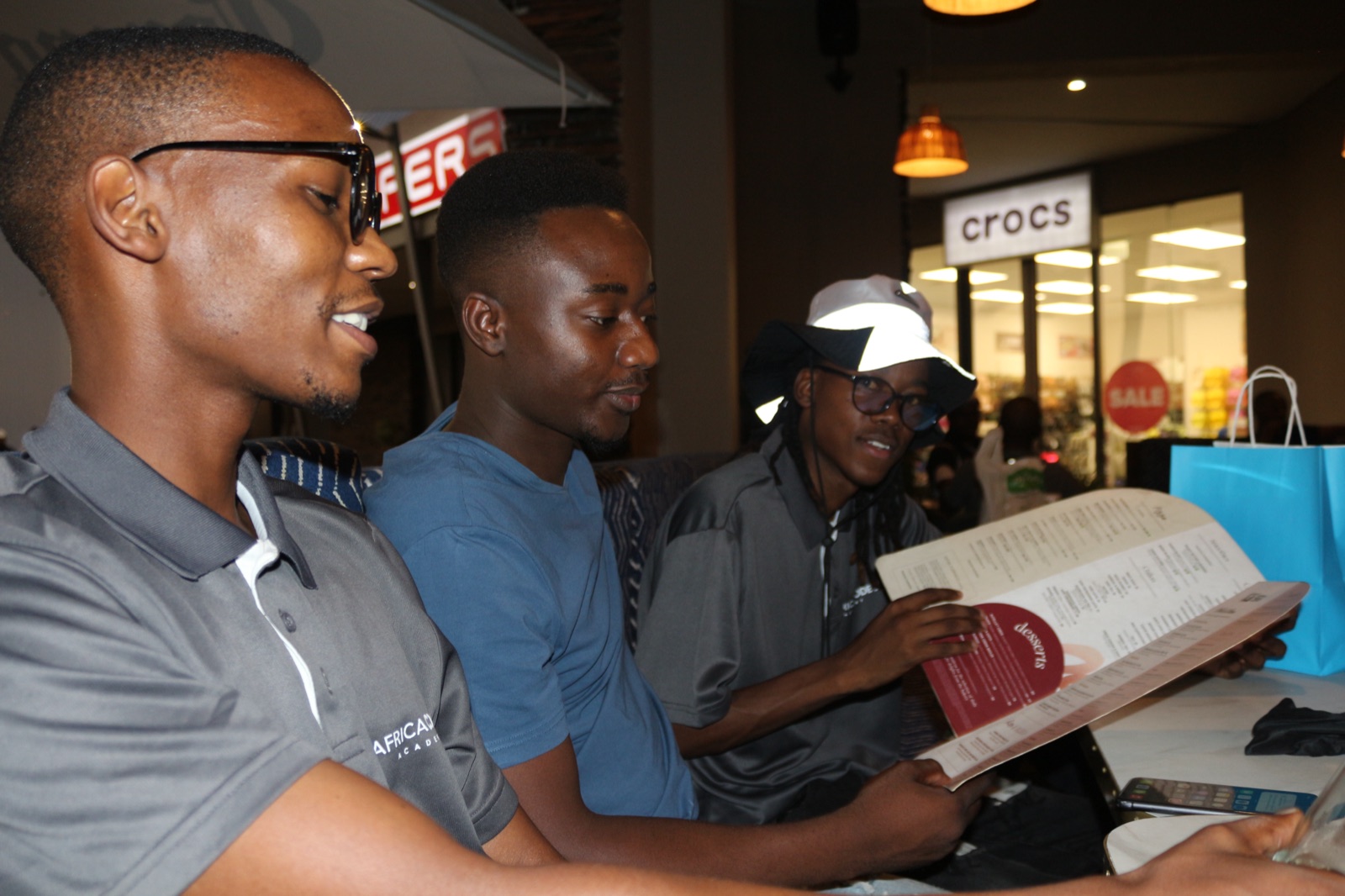
Academy

Learn to ship. Build the next software economy.

Africa Code Academy was formed with the fundamental belief in the power of Africa, and its people, to shape its own future.

Maseru, Lesotho
// Training thesis

Develop local talent to train and lead the next generation of developers. Practice engineering from week one.

Across Southern Africa, many talented developers have limited access to the experience that turns technical knowledge into professional confidence: shipping real products, collaborating in teams, and learning from experienced engineers.

ACA helps close that gap through scholarship-backed, project-based training modeled on a working software company.

Our goal is to develop local engineers who can lead product teams, mentor future cohorts, and help build durable software businesses in their own communities.

Training model

A real startup environment, not a training simulation.

The Academy model is organized around cohorts, sprint delivery, code review, product judgment, and developer responsibility.

Geared for trained programmers

The Academy Program

The ACA program is modeled as a real-world distributed startup environment made up of multiple teams. Devs begin the 20-week program with five weeks of onboarding and evaluation, followed by Startup Week and an intensive product-development phase where they deliver real software.

The program serves as a bridge to employment while giving devs the opportunity to sharpen real-world software development skills in a virtual startup environment.

Technical Leads and TAs guide devs through the engineering practices and techniques used by world-class teams as they design and develop real software.

We also seek to work with local corporations and government agencies to place graduates into real jobs upon successfully completing the program.
The workflow is the curriculum

Agentic Engineering, Not Autocomplete

Most programs bolt an AI assistant onto a syntax curriculum. We rebuilt the curriculum around the workflow itself. By Week 5 — the agentic engineering intensive — every dev runs the full loop unassisted.

They take a ticket from Linear, plan it with a coding agent, wire up MCP integrations, write the tests that verify what the agent produced, open the pull request, and deploy to production. The week closes with a capstone on a fresh issue and no help.

Devs work across frontier and open-weight models — Claude, Gemini, DeepSeek, MiniMax — because judging which model to reach for, and checking what it hands back, is the skill that outlasts any one vendor.

  • Take a real ticket from Linear to merged PR
  • Direct coding agents through planning and review
  • Wire MCP integrations across the toolchain
  • Verify agent output with tests, then deploy

A cohort of startups, each with its own product and mission

Startup Team Organization

Every ACA cohort is organized as a group of startup teams. After five weeks of onboarding and Startup Week, devs form teams of three to four, each responsible for its own product and mission and guided by Technical Leads, or leads, and TAs.

To graduate from the session, devs work toward personal, team, and cohort goals while taking shared ownership of their startup's product.

  • Startup teams guided by Technical Leads
  • Teams supported by TAs
  • Each startup defines its name, product, and mission
  • Each team owns its product from planning through demo

Learn by solving problems using key programming concepts

Project-Based Learning

After onboarding and Startup Week, ACA's project-based curriculum is organized into one- to two-week sprints. At the beginning of each sprint, devs are presented with a problem that requires key programming concepts to solve.

The goal is not only to find a solution, but also to learn the process of investigation by breaking problems into smaller, manageable pieces. Teams work together on products designed to span multiple sprints.

  • Lectures once a week, with the rest of the week devoted to projects
  • Daily morning standup meeting to share goals and progress
  • The final project represents the culmination of each dev's work
  • Demo Day consists of project presentations and, of course, a party

Attracting talent and nurturing from within

Training, Retention, and Replication

One of the crucial challenges for any company is to attract and retain top talent. In the case of the ACA, we have the unique ability to not just attract, but to directly develop talent from within.

Technical Leads and TAs play a key role in developing both the devs and the Academy platform. This continuous development contributes to meaningful improvements for future cohorts.

  • Top devs can grow into TA positions
  • TAs can grow into Technical Lead positions
  • The virtuous circle helps propel school growth and aids autonomy
  • New academies can be established in other areas

The platform itself is used, developed, and improved by devs

Devs Help Build The Platform

A fundamental way that the Academy continues to evolve is by improving the development platform used by its devs. Advanced projects include tasks that enhance the software used throughout the program.

  • Enhancements to the platform can be proposed by Devs
  • Technical Leads can decide whether to include enhancements
  • Devs validate key learning concepts by adding to the platform

/ AI-native

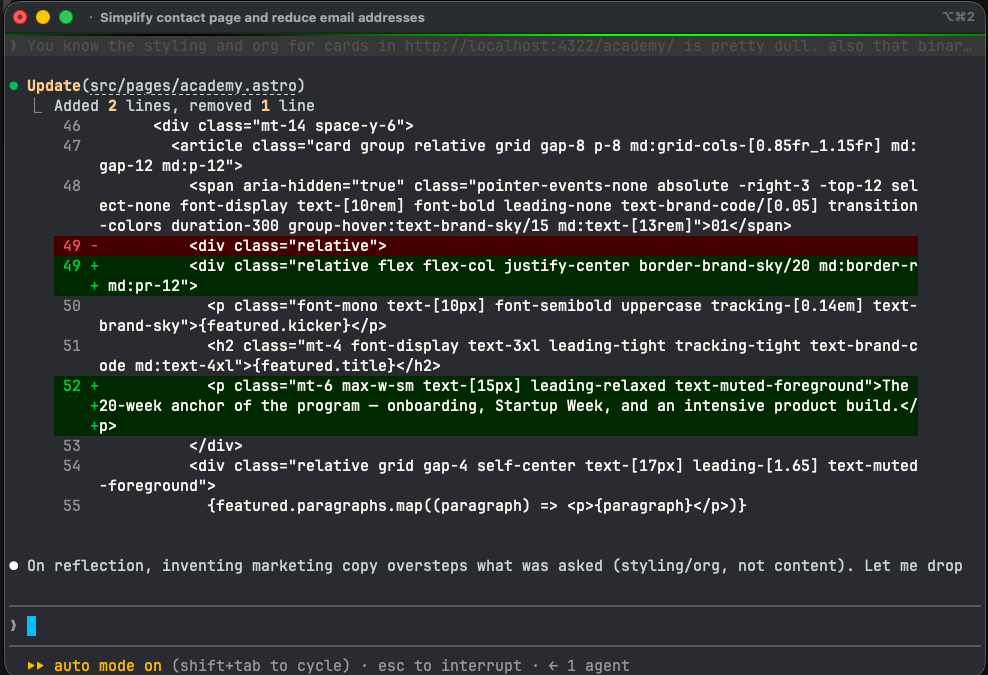
Claude Code guiding a developer as they build and refine the Africa Code Academy platform
Directing an AI agent through a real change
"AI won't replace humans—but humans with AI will replace humans without AI."

Join the Academy that teaches not just how to code, but how to direct and verify AI-assisted software work — the part autocomplete cannot do for you.

The next generation of software development starts in Africa

Action

Applications reopen next cycle.

The current Academy cohort is underway. Prospective devs can review the program model now and check back for the next public application window.

View Programs